New post
Avatar
0

Mac OS X, Finale 2014.5

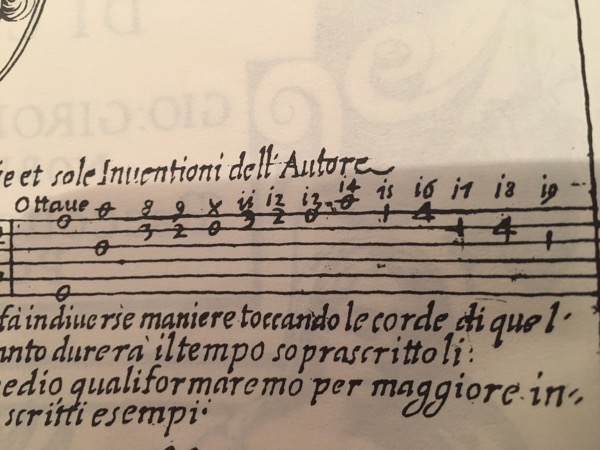
Is it possible to enter open bass strings below the sixth course in a tablature score using ledger lines or numbers?

This is relevant for transcription of Renaissance and Baroque Lute, Tiorba/Chitarrone, Theorbo sources.

EDIT:  adding an image per comment below.  The image below depicts octave equivalents in Italian tablature format for the strings 7 through 19 (open, typically un-fretted bass courses below string 6):
5 comments

Date Votes
Avatar
0

We may need to see an attached image of the layout since it is not clear, what the layout looks like.

Comment actions Permalink
Avatar
0

We may need some explanation of the attached image.


1) The “notehead symbols” at the beginning of the example, are they whole notes, or zeros?


You tell that the image depicts “octave equivalents”.

2) Are you saying that the image does not show the actual layout you need, but rather “equivalents” of the layout you need?

Comment actions Permalink
Avatar
0

1) - they are zeros with something like a ledger line through them to depict string 7

2) - the image shows the actual layout - in practice, these symbols "8" "X" and so on are used in place of additional ledger-line type notation to show pitches below the sixth or seventh string.

It is obviously possible to either design custom expressions or more likely, articulations (or try to work with existing fonts) but this creates a lot of extra work and causes some additional drag in note entry due to the fact that to create a "placeholder" for the articulation one must enter *something* in the tab - an erroneous note, so that note and beat spacing is preserved between a tab staff and modern notation staff above it.

If you hide the erroneous note/placeholder, the articulation is also hidden.  So you have to fiddle around with the anchors etc.

It may be that there is no real way around this.  But it is worth asking I think...  This is a common problem when working with 18th and 17th century sources.  A lot of these instruments had many more strings/courses than the typical 5 or 6.  And were typically notated using tab.  Many contemporary performers would use either the original tab (if its easy to read) or re-engraved tab (which affords the opportunity for easy transcription into modern notation) - hence the relevance to finale.

Comment actions Permalink
Avatar
0

I think I understand now.


However:

3) What did you mean by your words “octave equivalents”?


Some ideas:

a. As a “placeholder” in the TAB layout you could use a rest.

b. You could use the Expression Tool to add a {ledger line with number} where needed.

Comment actions Permalink
Avatar
0

3) - by this I only mean that the image depicts, for example string 7 (pitch x) and the equivalent pitch one octave higher (pitch x') - in this case on string 4.  The image is an extract from the introduction where the composer/author is describing how to tune the instrument and also how to read the tablature notation that follows in the rest of the pieces.

thanks for the feedback and help!

Comment actions Permalink

Please sign in to leave a comment.