New post
Avatar
0

 XP 14d

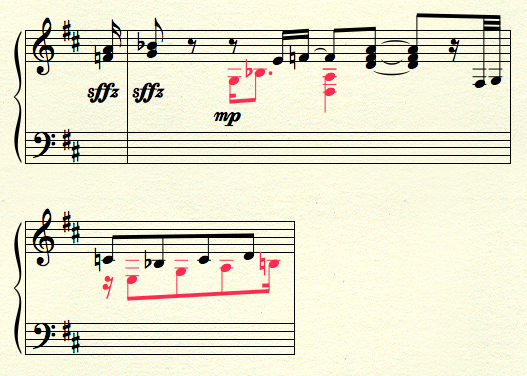
I think I want this measure
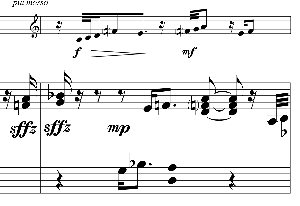
to have a common beam between staves something like this:
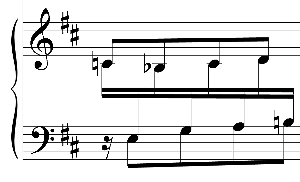
I did this several years ago, but I don't remember how, and the manual is woefully defective and incomplete on the subject. I can move the beams, but they don't connect.  The beam would have to be complex to account for the dotted figures and the quarter note, the purpose being to give a better reading of the complex rhythmic interrelationships. The alternative would be to just make the pianist count the beats until he/she figured it out.  I have a very competent pianist who is struggling with it.


5 comments

Date Votes
Avatar
0

Do you know the Cross Staff plug-in?


Plug-ins menu > TG Tools > Cross Staff…

Comment actions Permalink
Avatar
0

Tried that.  What I got was an unholy scrambled mess, all the treble notes scrambled on top of the bass clef notes.  What I remember doing was a manual click and drag.  I think in two layers.

Comment actions Permalink
Avatar
0

In the example you did “several years ago”, the cross staff beaming is done in a separate layer where you had only 16ths.


In the example you are trying to do now, you have to add the cross staff beaming notes in a separate layer.

Then use the plug-in on that layer only.

Comment actions Permalink
Avatar
0

It's a bit hard to see what your piece looks like on the basis of these two measures, but I would do more with 2 layers on one staff (see attached). Simplify the notation whenever possible - the sffz 16th note and rest can be renotated as a single eighth; the dynamic implies a short note value. I wouldn't let a dotted eighth straddle 2 quarter note beats - renotate as a 16th tied to an 8th. I know I said simplify the notation, but in this case you need to see the subdivision to see where the beats fall.


Comment actions Permalink
Avatar
0

Peter, Back to Gardner Read:  He shows (p. 307) an example of cross-staff beaming with a complex mix of note lengths and rests  That could obviously be applied here, but I now think that is not the best solution in this case.

Bruce, There is some merit in breaking the F dotted 1/8 with a tie.  That clarifies the rhythm.  I think I'll do that.  But other than that I find the beaming rather awkward, and I don't see the point, in this case, of moving the base clef notes to the treble clef.  I do that regularly when the notes are actually in the treble range, but here, with the notes actually in the bass range, I think it adds unnecessarily to the reading difficulty.  Same with the string of bass 1/8s appended to the treble.  It makes the pianist read too many ledger lines.  OK if the sequence were descending from B, but staring the string on E and going upward is counter intuitive.  Looking back at my example, in my score there are stems upward from the bass 1/8s to the center shared beam..


Comment actions Permalink

Please sign in to leave a comment.