New post
Avatar
0

Mac OS 10.10.5, Finale 2015.

After studying the manual, I thought I had figured out how to create a key signature where G# and A# are the only accidentals in an 8 note scale. Alas, I messed up. Can someone tell me how to create this signature? Thank you!


 

8 comments

Date Votes
Avatar
0

… a key signature where G♯ and A♯ are the only accidentals in an 8 note scale …


I suppose that you do not mean “7 note scale” - right?


But your words “a key signature where G♯ and A♯ are the only accidentals” only give a 7 note scale:

E♮ - F♮ - G♯ - A♯ - B♮ - C♮ - D♮


How do you get to an 8 note scale?

Please specify the 8 scale steps.

Comment actions Permalink
Avatar
0

Sorry, I should have been clearer. The "scale" is: D#, E, G, G#, A#, B, D nat., C#

So, accidentals are unavoidable in every bar, I just want to create a key signature that minimizes them. Thank you!

Comment actions Permalink
Avatar
0

Gary Eskow,


In your first post you only mentioned G♯ and A♯, you forgot C♯ and D♯.


But this is what you mean:


- right?


Or perhaps not (?)


The so called “Messiaen’s deuxième mode” is an octatonic scale pattern of

Semitone - Tone - Semitone - Tone - Semitone - Tone - Semitone - Tone


Your example can be changed into Messiaen’s deuxième mode by replacing {D♯ - E} with {E - F}:


Perhaps this is what you mean?

Comment actions Permalink
Avatar
0

Don't know if my response came through yesterday...here it is again...Thank you!

Yes, that's correct...I was basically trying to understand the process, thought I'd

nail down the specifics once I understood the fundamentals! What you've written is
the correct scale...
 
Didn't know Messian's mode...but that's not what the mode I'm using.
For the record, I actually switch between the mode above and the following:
 
D#,F,E,G,Ab,Bb,Cb,D
 
Thank you!!!
Comment actions Permalink
Avatar
0

Hi Gary,


For the scale I have written, I suggest that the only key signature accidentals are C and A.

Then, notate all occurrences of G and D with note accidentals instead.

This notation will minimize the number of note accidentals.


Here are the steps:


1) In the dialog box {Nonstandard Key Signature}, click on Next twice, to get to Linear Key Format 2 (since the Linear Key Formats 0 and 1 are “hardwired”).

For the Linear Key Formats 0 and 1 the first three “modification buttons” are greyed out. But in Linear Key Format 2 all five modification buttons are active.


2) Next, position the cursor inside the {Nonstandard Key Signature} dialog, and scroll vertically until you have 2 sharps.

The two sharps will be on F and C.


3) Click the button {Acc. Order}. The dialog box {Accidental Order and Amount} appears.


4) For Unit 1 (= the first sharp) the Step Level is 3 (= F).

Change the Step Level to 0 (= C).


5) Click on Next, to get to Unit 2 (= the second sharp).

Change the Step Level to 5 (= A).


6) FYI: Unit -1 is the first flat; Unit -2 is the second flat, &c.


7) When you have changed the Step Levels, you may need to move a key signature accidental to another octave.

To do so, click the button {Acc. Octave}.

You can set a separate octave for each key signature accidental, and in each Clef.

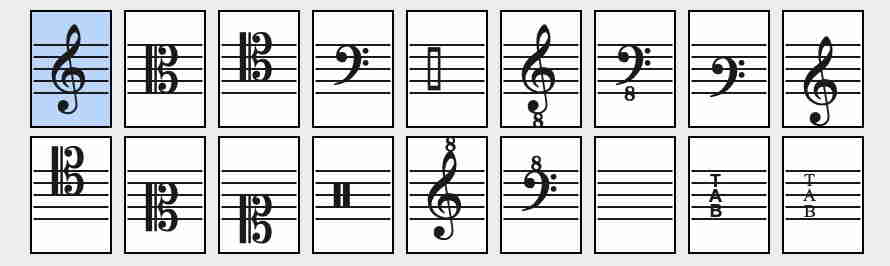
In a Finale document there are 18 customizable clefs, numbered from 0 to 17.

About the clef numbering:

The first Clef is Clef 0 = Treble Clef

The second Clef is Clef 1 = Alto Clef

The third Clef is Clef 2 = Tenor Clef

The fourth Clef is Clef 3 = Bass Clef

&c.

You can see the document’s 18 clefs in dialog boxes such as {Clef Designer} and {Clef Selection}.


By The Way:

If you transpose the scale up by a half-step, you get the simplest possible notation, namely a key signature with a single accidental of G, and with D as the only {note accidental scale step}.

Comment actions Permalink
Avatar
0

Thanks much!!!

Comment actions Permalink
Avatar
0

For the record, I actually switch between the mode above and the following:

D♯,E,F,G,Ab,Bb,Cb,D …


With a little enharmonic conversion the mode looks like this:

That mode is the “upside-down” inversion of the first mode.

For that mode, too, there is a transposition with the simplest possible notation of only a single key signature accidental scale step (A♭), and only a single note accidental scale step (D♭):

Comment actions Permalink
Avatar
0

Got it, thank you! Both modes have to be centered around the same tone...I think I'll finish this movement based on Eb on paper, since I have it in my head, and then take your suggestion and put it into Finale a 1/2 step higher. Hopefully, I will be able to understand my instructions!


Comment actions Permalink

Please sign in to leave a comment.