New post
Avatar
0

Before I get into the whole hullabaloo over suffix fonts and how they seemingly work in Finale I'd like to say that most of the program is user friendly except for the chord suffixes. It is very, very confusing and I'll explain why. Firstly there are a multitude of places where chord suffixes can be changed. All of them are different, and all of them handle the process to varying degrees of success and failure. 

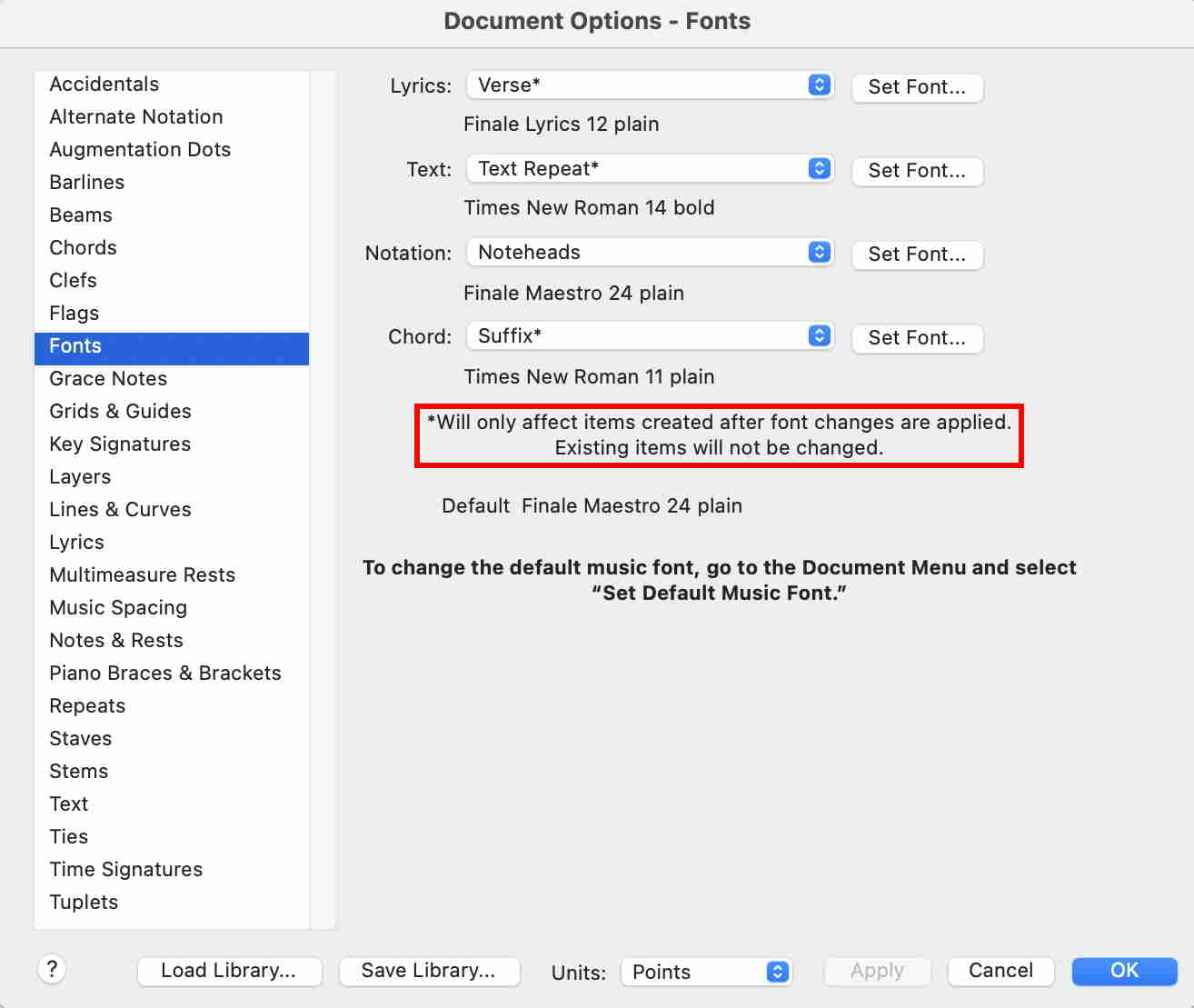
Let's look under Document>Document Options>Fonts>Chord>Suffix*

Hmmm. Nothing happens when I change the fonts or size of the fonts in the Suffix and then place them in my document. This is a fail. This option does nothing for me, therefore I will ignore the Options suffix setting. The other settings appear to work correctly under Document>Document Options>Fonts>Chord

Let's try adding a suffix library. That works, but as we will see it actually appends the new library to other libraries already existing in the suffix pool, (Chord suffix selection) That is buried deep within the bowels of the chord section. This is very problematic because in order to adjust anything meaningful you will need to definitely access this page.

The next option is to highlight the chord tool and from the chord menu that appears on top scroll down to Change Chord Suffix Fonts. A word to the wise. This option can be very dangerous and fraught with peril. Using this option can change every character in the suffix to the font that is chosen. 

I think that a little explanation is needed here to describe how the suffixes and the associated fonts really work. Simply put, a single suffix can have multiple different fonts. Therefore, a D#∆7 chord where ∆7 is the suffix really consists of two different fonts and two different sizes. Crazy right? How can one expect the first option listed above to even work right where you have two different fonts involved with only choice for one font. 

Click on the chord tool, and in the chord menu at the top scroll all the way down to Change Chord Suffix Fonts... Here you will wind up with a similar dilemma if you select Search for All Fonts, and then replace them with a single font. Only with this setting you need to me a little bit more careful, since this will also change the Chord suffix selection pool. How to get there to see what's really going on? With the chord tool double click on an open bar of music and the chord definition box will come up then click on advanced settings. Look down at the suffix section. You will see a box with ID: 0 and then another button with the work select.. Click on that. This is the only process that allows you to see and accurately edit or create each of your suffix fonts. Highlight one of the boxes with a symbol and number in it. The chord suffix editor should come up. So for this symbol ∆ it is a Maestro 36 font size and for this symbol 7 it is an Arial 14 font size. 

If that doesn't confuse you then just look at this:

Using Change Chord Suffix Fonts will change some or all of the suffix fonts unintentionally in your current Chord suffix selection pool. It can really knock things out of whack. My suggestion for Finale, get rid of option 1 listed above. Combine the windows for Change Chord Suffix Fonts with the Chord suffix selection table, and get this modified window placed in the chord menu where Change Chord Suffix Fonts currently exist. It would be good to have a sample display where you can view changes in real time before committing to save to the whole table. Thanks, Pete.

Mac M2 Pro

Ventura 13.4.1


13 comments

Date Votes
Avatar
0

… Let's look under Document>Document Options>Fonts>Chord>Suffix*

Hmmm. Nothing happens when I change the fonts or size of the fonts in the Suffix and then place them in my document. This is a fail. This option does nothing for me, therefore I will ignore the Options suffix setting …


Note the asterisk * after the word Suffix: Suffix*


If you create new chord suffixes after the font change, then the new suffixes will show up in the Chord Suffix Selection, and the new suffixes will have the changed font/font size.


In Other Words:

This setting is the default font setting for creating new suffixes.


Comment actions Permalink
Avatar
0

I've tried to create items after font changes are applied. Nothing happens. It remains the same font. What used to happen is that this setting would change all of the suffix fonts so that if the suffix fonts were a combination of Maestro and Arial, and I wanted Broadway copyist, it would change everything to Broadway copyist. Since this font set didn't contain some of the symbols that Maestro contained I used to either get a different symbol or the ubiquitous question mark. For me this setting is to be avoided as it does not produce the intended result. 

Comment actions Permalink
Avatar
0

… I've tried to create items after font changes are applied. Nothing happens. It remains the same font …


If I understand you correctly, you changed the default font for new suffixes (Document Options > Fonts > Chord > Suffix*) - right?

And next you tried to create a new suffix (…tried to create items…) in the Chord Suffix Editor - right?

But the Chord Suffix Editor did not default to the changed font - right?


Unfortunately I am unable to reproduce your problem.

My steps:

1) Document Options > Fonts > Chord > Suffix*

I changed the default font for new suffixes to Helvetica 12.

2) Went to the Chord Suffix Selection, and clicked the button Create…

3) Finale opened the Chord Suffix Editor which now defaulted to Helvetica 12.

Comment actions Permalink
Avatar
0

Did you lose any suffix characters that were Maestro that then changed to Helvetia after performing this operation? I noticed that on my older iMac. I am wondering if this has anything to do with the font handling differences between systems. Currently I am using Mac M2 Pro
Ventura 13.4.1

Comment actions Permalink
Avatar
0
Comment actions Permalink
Avatar
0

Version: 27.3.0.160

Comment actions Permalink
Avatar
0

Actually I am using Maestro because it appears to contain more symbols than Finale Maestro does.

Also, I am no longer using the iMac listed below. I'm using a Mac M2 14" with 32 GB ram, and 2T hard drive. It runs Ventura 13.4.1

Comment actions Permalink
Avatar
0

Actually, it is the opposite : FinaleMaestro (SMuFL font, included as default in Finale 27) offers more symbols than the "old" Maestro font.

Comment actions Permalink
Avatar
0

You are right. My mistake. 

Comment actions Permalink
Avatar
0

It still doesn't explain the problems that are present with the set up.

Comment actions Permalink
Avatar
0

Peter Buchta,


Just to make things clear - to explain my steps:

In this context a new item is a new chord suffix, not a new character in an already existing suffix.

When I create a new suffix, in the Chord Suffix Editor, at first there are no suffix characters at all.

As I add characters to the suffix, they default to the default font:

Helvetica 12.

If I, for one specific suffix character, need a different font than Helvetica 12, then I need to change the font for that specific character.

Comment actions Permalink
Avatar
0

Correct. 

Note that all of the fonts change to Helvetica using the Change Suffix Fonts under the Chord Tool Menu. The Document Menu  Font selection, suffix fonts doesn't appear to do anything anymore with my set up. Since every time I screw up my Chord suffix fonts set up I have to redo the whole thing, I just don't have the time to experiment with this and beta troubleshoot it. I hope that everyone understands. Best, Pete

Comment actions Permalink
Avatar
0

BTW I stuck with using the Arial Large suffix library and readjusted the Finale Maestro fonts to acceptable sizes. I saved the suffix library and now I'm satisfied with it. Of course, I still need to make changes along the way if I feel that a suffix is unacceptable.

Comment actions Permalink

Please sign in to leave a comment.