New post
Avatar
0

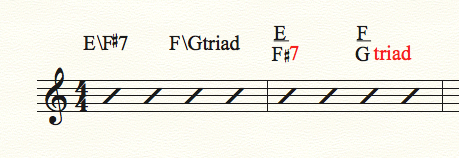
I would like to know how to simply create the following style of chord symbol with a backward slash:

E\F#7  or   F\Gtriad

When I try to put an F#7 after the backwards slash, Finale won't display the 7. Or the word "triad"


macOS Sierra 10.12.6

Finale 25.5.0.259

Thanks 

Bobby

6 comments

Date Votes
Avatar
0

How did you manage to make the Chord Tool accept a backward slash?

I can only get a forward slash.


By The Way:

I have never before seen a chord symbol with a backward slash.

What does it mean when the slash is backward?

Comment actions Permalink
Avatar
0

Finale thinks that everything you type after the chord root name is a chord suffix, with four exceptions: spacebar to advance to the next beat, the forward slash and the vertical line (shift backslash) for alternate bass notes, and the shift hyphen for polychords.


For polychords, Finale won't allow any suffixes after the shift-backslash. This is a long-standing bug. What I suggest is to enter two chords separately and then create the slash as an expression and position it carefully at 400% zoom.


I also don't know what a backslash means in a chord symbol, but I imagine you have a good reason.

Comment actions Permalink
Avatar
1

>I also don't know what a backslash means in a chord symbol, but I imagine you have a good reason.<


Since the object of notation is to enable others to perform a work knowing the composer's intentions, a good reason is required so that there's a clear understanding. If there's a standard way to accomplish the goal, no reason to invent a new one.


My 2¢

Comment actions Permalink
Avatar
0

Bobby, are you trying to get an F#7 chord with E in the bass, and a G triad with F in the bass? If so, the usual notation would be F#7/E and G/F, using a forward slash with the chord before the slash and the bass note after the slash.  Or do you mean something else?

Comment actions Permalink
Avatar
1

I've never seen a backward slash either. Anyway, here's what I came up with.

The first measure with the backward slash, I created one suffix that was: "\F#7" and the other suffix "\Gtriad", so the backward slash is part of the chord suffix.


The second measure is how I've seen polychords, stacked vertically. Finale can do this but you have to enter the lower chord suffix as an expression.


Both methods are laborious and should be updated.

Comment actions Permalink
Avatar
0

I'm doing a gig and the MD is a Berklee grad. Berklee calls them Upper Structure Triads. For example, an F7\Gtriad means you play an F7 in the left hand and a G triad in the right. The backward slash to me seems more like a definite polychord symbol. I've seen many handwritten charts over the years where the transcriber has used the straight line with chord above, chord below. Their intention was to indicate an alternate bass chord. They used the straight line with the chord on top and the desired bass note on the bottom, which meant the same as the forward slash. Using Shift/Hyphen gets you the straight line above, but, the suffix still will only display a chord by itself. ( a G, or an F, etc,  instead of a G7 or Ftriad. That's why Jeffrey had to enter the bottom word "triad" and the "7" as an expression. 

When I saw the backward slash chords at the first rehearsal, he explained the logic behind it. Made sense to me! 

This link ( https://www.youtube.com/watch?v=5ZymO9ZdtwQ&feature=youtu.be ) shows a way to make the straight line above the chord, but allows me to use an F7, F#7, Gtriad, whatever, on the bottom as well and any chord I need on top.

Thanks for everyone's input. It's good to know there is reliable help here for the asking. 

Bobby

Comment actions Permalink

Please sign in to leave a comment.