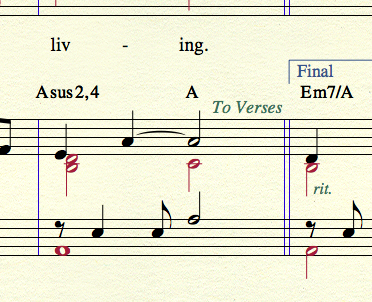
I am trying to notate a chord as Ab2 (no 3) and Finale won't accept it - changes it to something else. Are there ways to do this? It's the "no 3" part that causes the problem.
Win 7, Finale 25.5


As I said, you need to create a chord suffix. That's not the same thing as typing it in.
When Finale doesn't recognize your chord symbol, it gives you the option of adding the suffix to the library. Click yes and create the 2 no3 suffix..
You only have to do this once for each suffix. The next time you need this suffix you'll be able to type it in. This custom suffix will only exist in this specific document. You don't want to have to create this each time you need to use it. So, you should save a library consisting of chord suffixes. You'll be able to import that library into other documents. Or add this chord suffix into a template, and use that template to begin other projects with.
To keep your Cb chord, in the chord tool menu, uncheck "simplify spelling".

Kathy,
Actually that should be part of your job. Let the composer/arranger know when they've done something that is out of the ordinary, or written it in a way that could be written easier. Some composers will thank you for your insight and agree to your suggestions. After all, they are not notation experts. Other composers will insist reproducing what they wrote, then you're off the hook.
Good luck.
Elaine Gould was a copyist. Just sayin'...
https://www.scoringnotes.com/people/interview-elaine-gould-part-1-early-years-faber/
https://www.scoringnotes.com/people/interview-elaine-gould-part-2-behind-bars/
Sometimes, copyists have to save composers from themselves.
When I was a studio and pit orchestra guitarist, I carried an assortment of Magic Markers and Sharpies to correct such mistakes in permanent ink. Pencils were for director/conductor decisions and notes to myself. I got tired of seeing show scores with the same mistakes corrected in pencil and erased over and over and over. Having done it over four decades, it wasn't unusual to see books I had played reappear on my stand years later.
Not to get to far into the music theory weeds, but..... It's been awhile since I was in college theory classes (theory major here), but I think the reason the arranger didn't use Ab2 sus is because it's not actually a suspension. The note D (which would make it a sus chord) is not there. The spelling, bottom to top is Ab Bb Eb, and so it remains something of an open chord, functioning as the IV chord in the key. Does that make sense?
Thanks for the links. They look very interesting!

Mike,
Can you clear up a mystery for me?
I frequently would include the C and have the Bb resolve down to Ab, but since I would not be including the 7th, this would not be an Ab9. People seem to argue endlessly about the meaning of some chord suffixes, so I'd love to have your take on how to distinguish the chord above from Ab Bb C Eb resolving to the triad.
(Sometimes I think it's just as wise to follow Jeanine Tesori's practice and not include chord symbols at all. :-)
Mike, I get your point. What you said makes total sense. I'm old school and tend to think of suspensions as resolving, but that's obviously not the case anymore. Kind of gives the feel of cluster chords. At any rate, the arrangement in question is for kids' choirs in churches, and the underlying assumption would likely be that in many situations the instrumentalists would be amateur (and perhaps self-taught) rather than professional. I think the reason she wrote the chord as she did is so it might be quickly understood that there is no 3rd in the chord. Maybe an instance of knowing who you are writing for.
Thanks for the input. It's something I can use in the future!
Yep, although I would play Ab2 as Ab, C, Eb, Bb because I like the sound.
>FWIW, one of the publishers I engrave for is for church music. And we have both "sus2" , "sus4" and "sus 2,4" in our templates.<
Don't get me started. Those are the hallmarks of praise band church composers with no imagination for the last 40 years! Really, those chords were hip when Pete Townsend wrote Behind Blue Eyes in 1971 (48 years ago). Then U2 beat them to death in the 1980s–'90s. Then the KLOVE crowd glom'd onto them and it's never stopped.
>the underlying assumption would likely be that in many situations the instrumentalists would be amateur <
Then write it out as an instruction when you explain the chart. Why write it incorrectly?
I'll be quiet now.
Please sign in to leave a comment.
18 comments
Date Votes