New post
Avatar
0

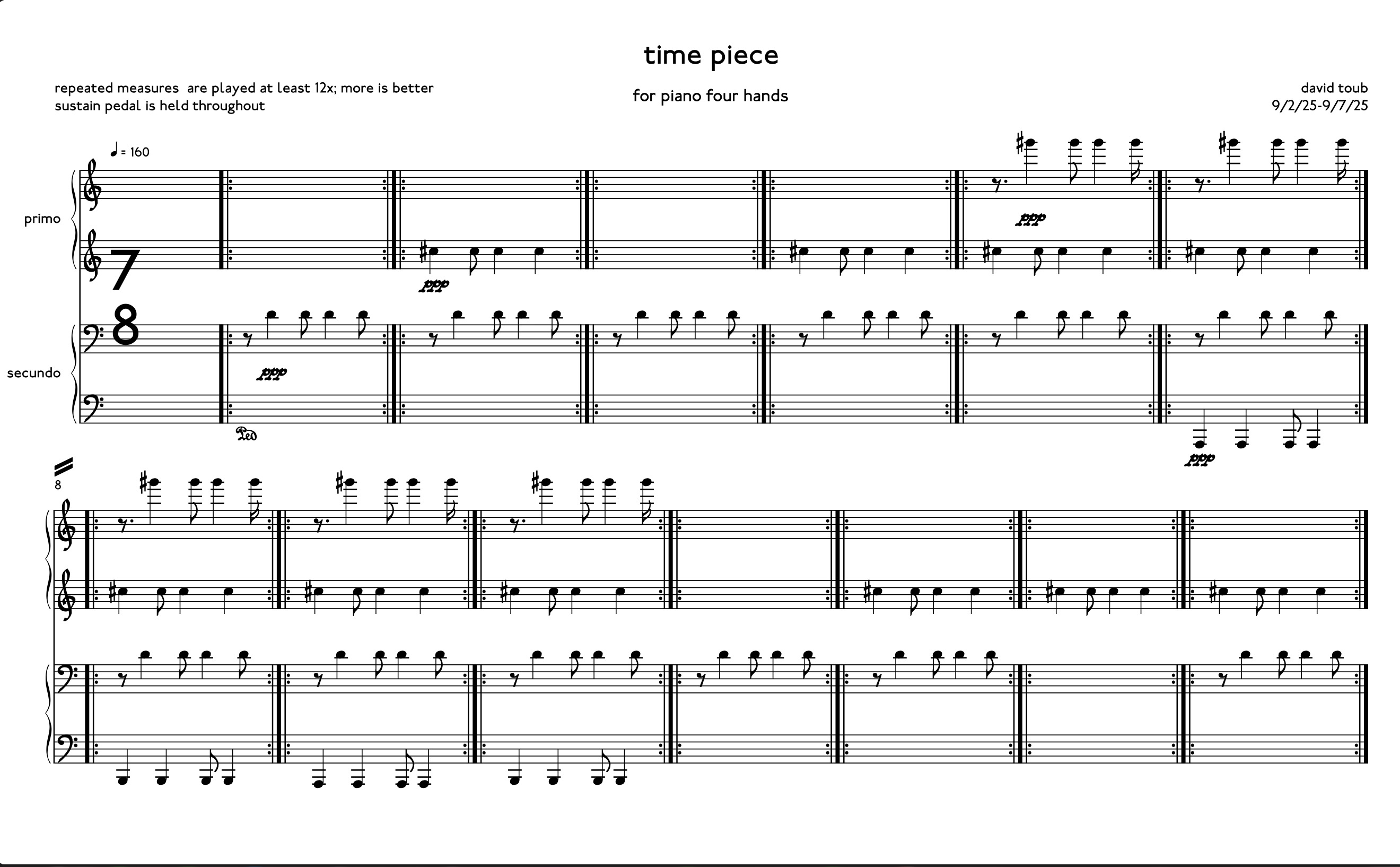
Just a comment on that - wish I could connect my comment to the relevant post. The one in question shows a score with enormous time signatures at the beginning with 2 or 3 space ed vertically under it, then a few more as the time signature changes - all enormous. Who benefits from these big time signatures? I'm guessing the person conducting the piece. Since forever, conductors have been marking their scores as they like. Ernest Ansermet used red and blue pencils for various markings. We in the l'Orch. de la Suisse Romande were forbidden to erase or alter them. Anyway, my question as a musician, and Finale user, and arranger, why do you like to use these enormous time signatures? Because you like the way they look? Well, that's subjective, isn't it. Plus, a big time signature uses valuable space on the score and pushes all the notes to the right to make room for the enormous time signature. That doesn't look good to me. A measure with 4 quarter notes has a certain size. Put an enormous (yes, I like writing that word) time signature at the beginning of the bar and now that 4/4 measure is stretched to the size of a 6/4 or 7/4 bar. Not good; not logical. Final comment/question - are the enormous time signatures also in the individual parts? I'm guessing they are probably not. Apparently, Dorico doesn't like the enormous time signatures either. I'm no fan of Dorico, btw, I'm sticking to Finale and not using enormous time signatures. 

Dennis Anthony Guterwicz

Finale - 27.3.0.160

OS 14.7.4

9 comments

Date Votes
Avatar
0

Wow-this is a lot to unpack. Is there a question here (other than why some of us prefer large time signatures) or just a polemic about why you are sticking with the now-demised Finale?

I do like, and use, large time signatures. I do not compose for orchestra, and on purpose, but that's my preference. But I think it is more obvious when the time signature is large (I also make sure metronome markings are a bit larger than normal), and yes, I do like the look. Some people like cutaway scores (they are not clearly easier to follow, from most accounts and I also agree with that sentiment) and others don't use them. Each to her or his own.

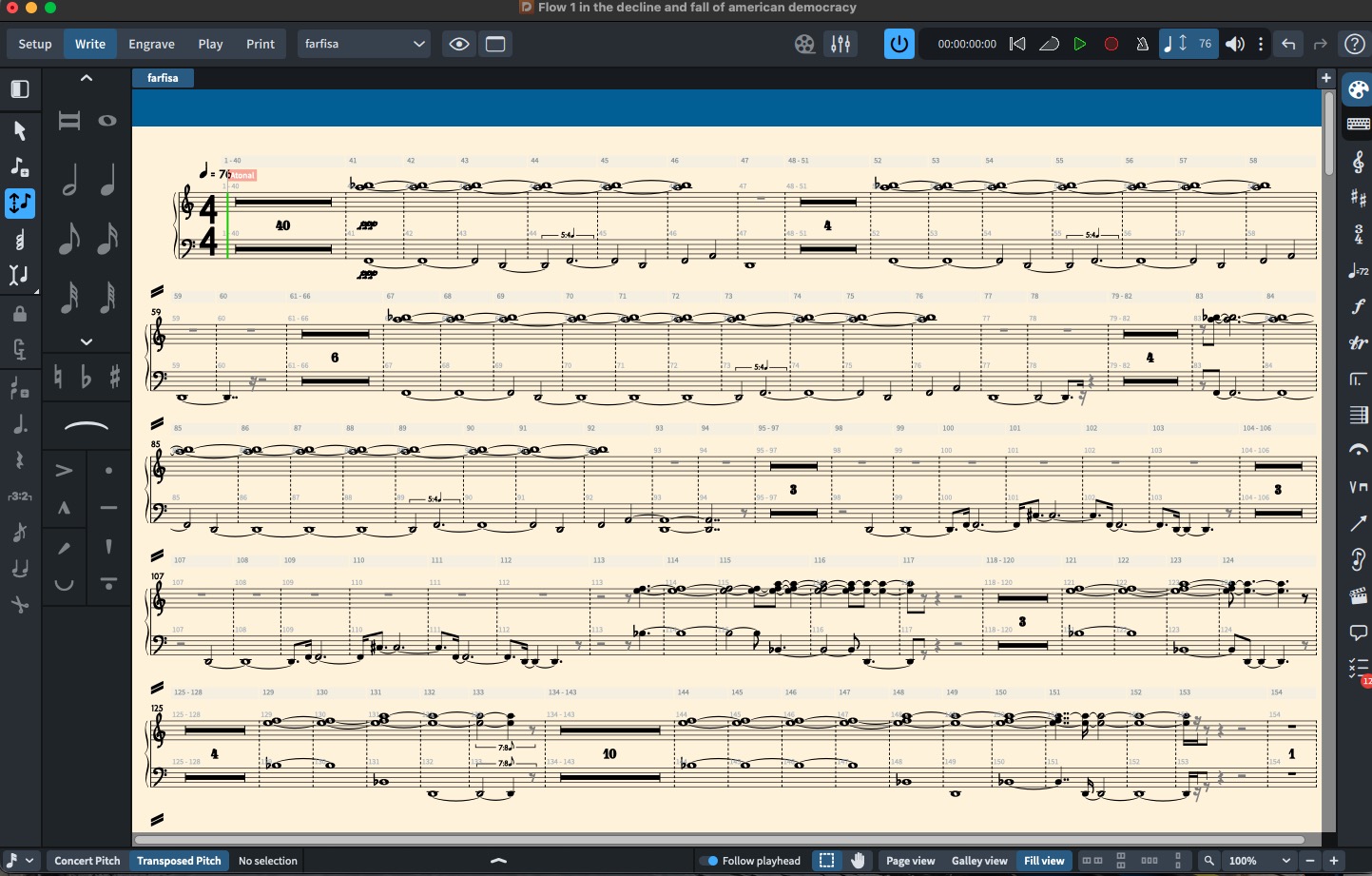
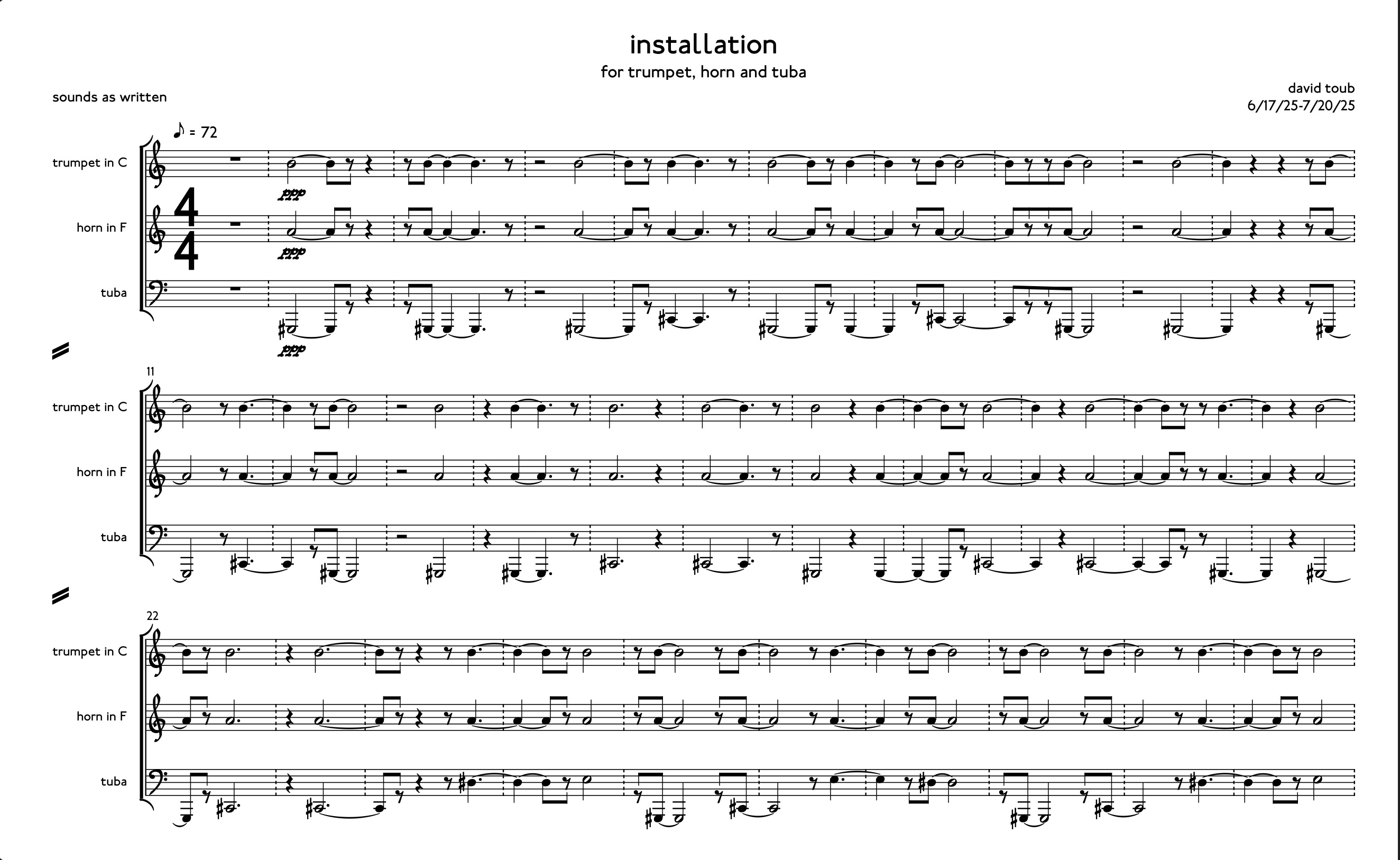
But I disagree with your contention that Dorico "doesn't like the enormous time signatures." I've now composed eight works in Dorico since I left Finale behind last September rather than keep using a cadaveric notation program. Dorico offers several preferences for how large time signatures appear, and it's so much easier to use large time signatures in Dorico than it ever was for me in Finale. No bogus cryptic guesstimates for font size or position of the top and bottom numbers (I wish I had a nickel for every minute that was wasted by making the numbers larger and smaller with a non-WYSIWYG system like Finale's Document Options). Here are two examples, both using Dorico (the first measure of my music is always empty, so each piece starts with a moment of silence):

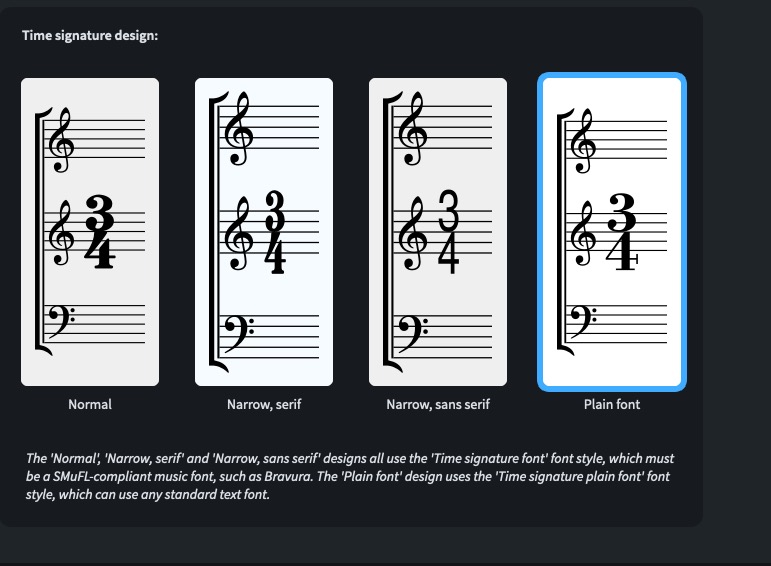
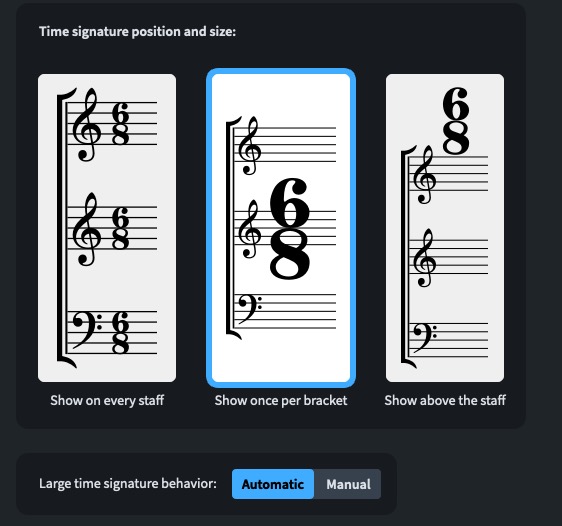
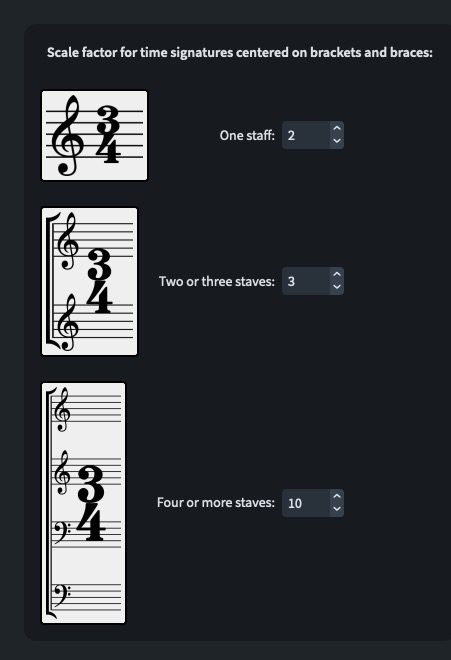
Here are Dorico's preferences for large time signatures. Very easy to use. If Dorico "didn't like" large time signatures, I doubt there would be a lot of options for layout, etc. And Dorico is a software program; it doesn't like or dislike anything.


And yes, one can have large time signatures in parts as well-totally at one's discretion for each part.


Comment actions Permalink
Avatar
0

In Document Options -> Fonts -> Time (Score), you can use Engraver Time, which is narrow. If you define a large size, you will have to modify the vertical values of the numerator and the denominator. It can be done in Document Options -> Time Signature -> Vertical adjustment.

Comment actions Permalink
Avatar
0

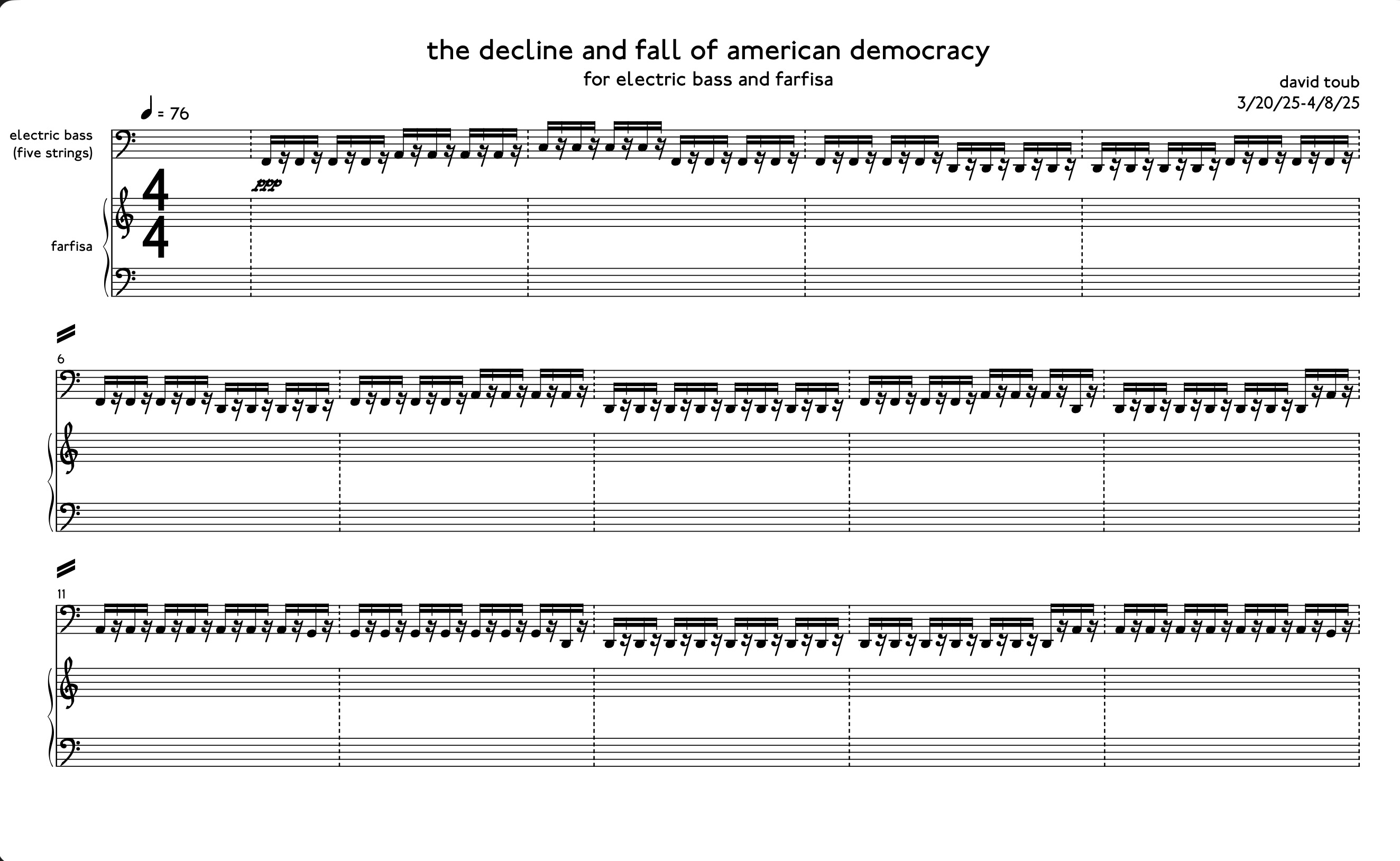
Mr. Toub, my comment which was misinterpreted to mean "Dorico does not like big time signatures" was a reaction to someone who mentioned that when trying to open a Finale file that had big time signatures in Dorico, the big time signatures don't transfer properly. On a different note, as a professional trumpeter with 40 years of experience, I would not like to see a part like the one in your "the decline and fall....". It is unnecessarily cluttered. Why not just write eight staccato 8th notes instead of 8 16ths separates by 8 16th note rests? Maybe you were being ironic in writing that way since the title mentions decline and fall. Have you thought of perhaps writing 8 32nd notes separated by 8 dotted 16th rests to enhance the irony? 

Comment actions Permalink
Avatar
0

You might want to check out the performance here or on spotify. I am actually very careful and purposeful about my notation and very much meant those notes as notated (as I've done in a few other scores of mine). The short notes have nothing whatsoever to do with the title. But thank you for your feedback nonetheless. I have a recent work for trumpet, tuba and French horn that might be more to your liking; here's the first page:

For me, the biggest issue with large time signatures in Finale is the need to guess tweaks to the top and bottom numbers in terms of their positions. It's much nicer the way Dorico does it. I suspect that depending on how the mXML goes, Dorico may or may not import them properly. That was one of the reasons (but only a minor one; there are more significant issues) why I just didn't bother trying to export my 30+ years of Finale files to Dorico. YMMV. 

Comment actions Permalink
Avatar
0

Hello again. I just want to focus now on the way you notated "decline and fall..." Why that particular way? Is it for the visual effect? Does it affect the sound? Not trying to be a jerk, just want to understand. i will tell you this, as a professional musician with 40 years of experience in major orchestras, I have never seen that - sure, a measure here or there, of course. Again, I don't understand why. Also, as a professional, I would absolutely play a piece that is written like that to the best of my ability (it's not more difficult, btw). I would not be happy to have to read something that consider "unusual" when there are "better" ways of writing a series of staccato eight notes. I'm sure you want your pieces to sound as good as possible, and one way to achieve that is to have happy musicians. Just a suggestion, worth what I charge for it. So, I'm done. I'll see myself out. Thanks.

Comment actions Permalink
Avatar
0

No, it is not like that because I think it "looks" better. It's that way because staccato eighth notes at that speed would not sound like what I'm getting at, and the way I notated it is appropriate. No notation is going to please every musician. You don't love large time signatures and, apparently, 16th notes interspersed with 16th rests. That's fine. Some folks don't like beaming over barlines. Some people hate complicated tuplets and question why do them when it might not be played correctly. Yadda yadda yadda. My scores are hardly that complex compared to many (you must really hate Feldman's scores, or Ferneyhough's or Carter's or Shapey's). I just had a piece premiered in Brazil. Another is about to be out on CD along with another work of mine and one of these is getting performed in Brussel next month (I'm flying over for that). I know my music is not easy, even when it looks ridiculously simple. I appreciate your feedback and suggestions and am certainly not notating my music in order to piss off musicians. Hardly.

Comment actions Permalink
Avatar
0

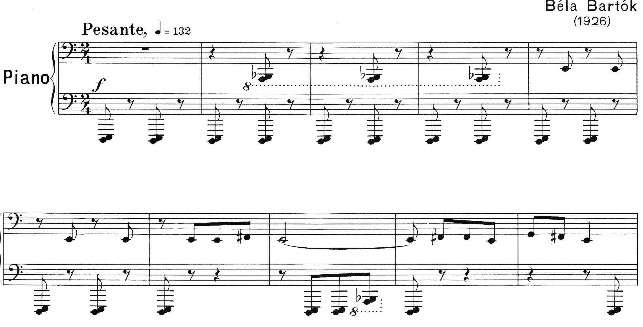
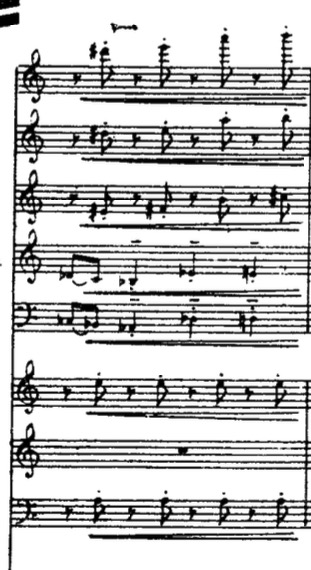
And no, I did not steal this from Bartók:

Or Feldman:

Or Hindemith (who uses rests and staccato markings, redundantly)

Or Stravinsky (this is right out of Le Sacre du Printemps):

My point is that what you're commenting upon is really not "out there." I tend to avoid articulations unlike many of my earlier works. My scores tend to be sparse and on purpose, and using rests as needed makes it clear, at least to me, what the specific durations of each note is. Just a preference, but I don't see why it makes things "unusual" 

Comment actions Permalink
Avatar
0

Thanks for these examples.

To paraphrase Fats Waller - "How do it sound?" (Not "how do it look"?)

Comment actions Permalink
Avatar
0

Exactly. I’m much more concerned with the music itself and the notation is a distant third. I’d rather someone tell me that they like or hate my music than only raise an issue with the notation. Perhaps if you heard the music, it would be more clear why I notate things the way I do (and honestly, for the most part, my music is very conventionally notated).

Comment actions Permalink

Please sign in to leave a comment.